OUR VISION
Mastering light to master terahertz waves.
We pursue two complementary directions: frontier research that pushes devices to their physical limits, and real-world deployment research that turns those advances into technologies society can use. Together they drive our work to pioneer next-generation information and communication technologies that merge photonics and terahertz technology.
At the core of our research is photomixing: two light waves are injected into an ultrafast photodiode (UTC-PD), generating a terahertz wave at the frequency difference between them.
Our research currently rests on two pillars: frontier research that expands the limits of terahertz technology itself, and deployment research that carries that technology into communications and sensing.
A. FRONTIER RESEARCH
Pushing the limits of terahertz technology
01 High-Power Photomixer Arrays
Toward higher terahertz output power
Raising the output power of photomixers is a key challenge in putting terahertz waves to practical use in communications and sensing.
We integrate UTC-PDs on thermally conductive SiC substrates with ultra-high-frequency circuits, and we arrange multiple UTC-PDs into arrays whose terahertz outputs are coherently combined.
An 8×1 UTC-PD array that integrates eight UTC-PDs, a T-junction power combiner and an antenna achieved an output increase of about 16 dB at 300 GHz compared with a single UTC-PD.
By combining two UTC-PD/SiC photomixer modules in a terahertz waveguide, we have also achieved output power at the 5.3 mW level.
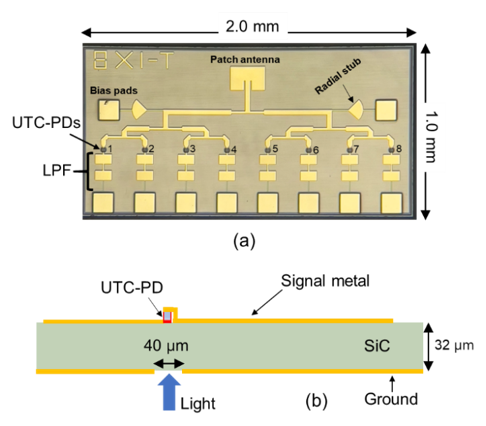
Source: H. Ssali et al., “Generating Enhanced THz Power via an 8 × 1 UTC-PD Array Integrated with a T-Junction Combiner,” 2025 Asia-Pacific Microwave Conference (APMC), DOI: 10.1109/APMC65046.2025.11378753
02 Photonic THz Beam Control
From high-speed beam steering to multi-beam generation
Because terahertz waves travel in highly directional beams, technology that points them accurately and quickly toward a communication partner or target is essential.
Rather than electronic phase shifters, we use the wavelength of light and the chromatic dispersion of optical fiber to control the phase of terahertz waves — a beam-control approach of our own.
Combined with a fast wavelength-tunable laser, this approach has achieved beam switching between −27° and +18° on a nanosecond timescale.
Building on this, we are developing multi-beam technology that forms several terahertz beams simultaneously from a single photomixer array by using different combinations of optical wavelengths.
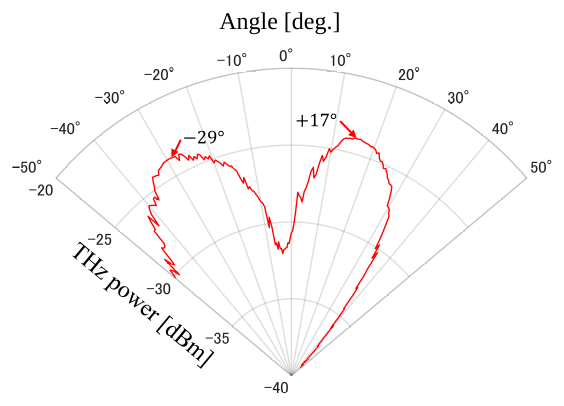
Source: Y. Kamiura, M. Kawano, Y. Mikami, and K. Kato, “Photonic generation of terahertz multi-beams by photomixer arrays exploiting fiber chromatic dispersion,” Optics Letters, Vol. 51, No. 4, p. 937, 2026. DOI: 10.1364/OL.583514
B. SOCIAL IMPLEMENTATION
Bringing terahertz technology to communications and sensing
03 High-Capacity & Secure THz Communications
Carrying the capacity of optical fiber into wireless space
The extremely wide bandwidth available at terahertz frequencies promises next-generation wireless communications with ultra-high speed and capacity.
Building on high-power SiC-based UTC-PDs and high-frequency module technology, we study higher-order modulation formats such as QPSK, 16QAM and 32QAM, frequency-division multiplexing (FDM) that uses multiple frequencies simultaneously, radio-over-fiber, and the integration of beam control with communications.
Recently, we generated two 16QAM signals at 257 GHz and 277 GHz simultaneously from a single high-power SiC-based UTC-PD and transmitted a total of 40 Gbit/s over a distance of about 16 m.
We are also extending this work to frequency-hopping communications that switch the terahertz frequency on a nanosecond timescale through fast optical wavelength control, making links resistant to jamming and eavesdropping.
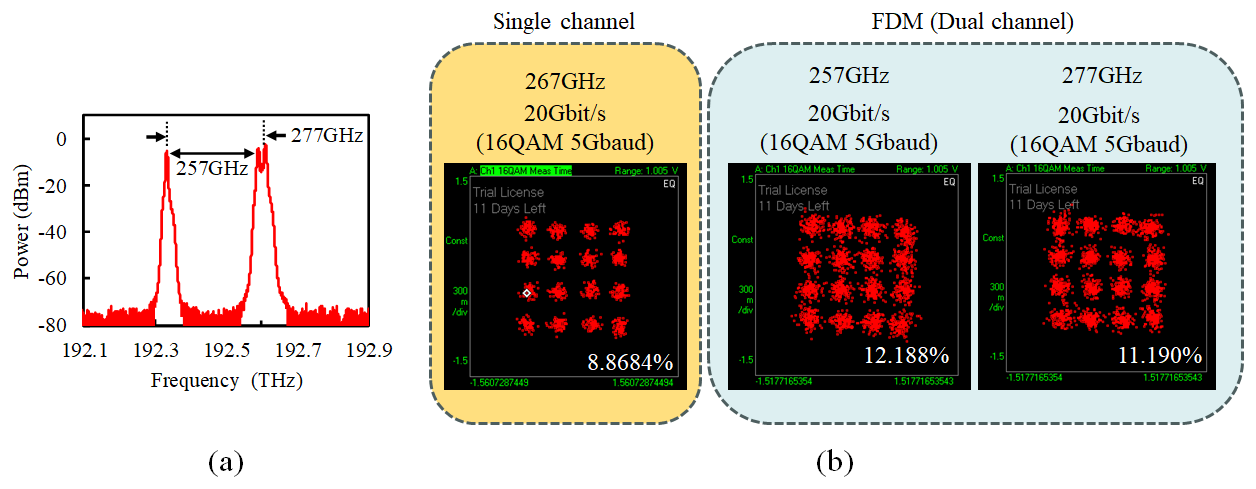
Source: Y. Kamiura et al., “A Single High-Power SiC-Based UTC-PD Enabling a 40-Gbit/s Two-Channel FDM-THz Link,” Optical Fiber Communication Conference (OFC 2026), 2026.
04 THz Sensing & Integrated Sensing and Communication
Communicating and measuring — as one
The wide bandwidth of terahertz waves is valuable not only for high-capacity communications but also for radar and sensing with high range resolution.
We combine a fast wavelength-tunable laser with photomixing to build THz-FMCW radar that sweeps the terahertz frequency at high speed.
Using a delayed self-multiplexing scheme with a single tunable laser and optical fiber, we generated multiple FMCW waveforms — sawtooth, triangular and dual-chirp — and achieved ranging errors below 1 cm.
We are now extending this work to ISAC (Integrated Sensing and Communication), which performs communication and sensing simultaneously with the same terahertz signal.
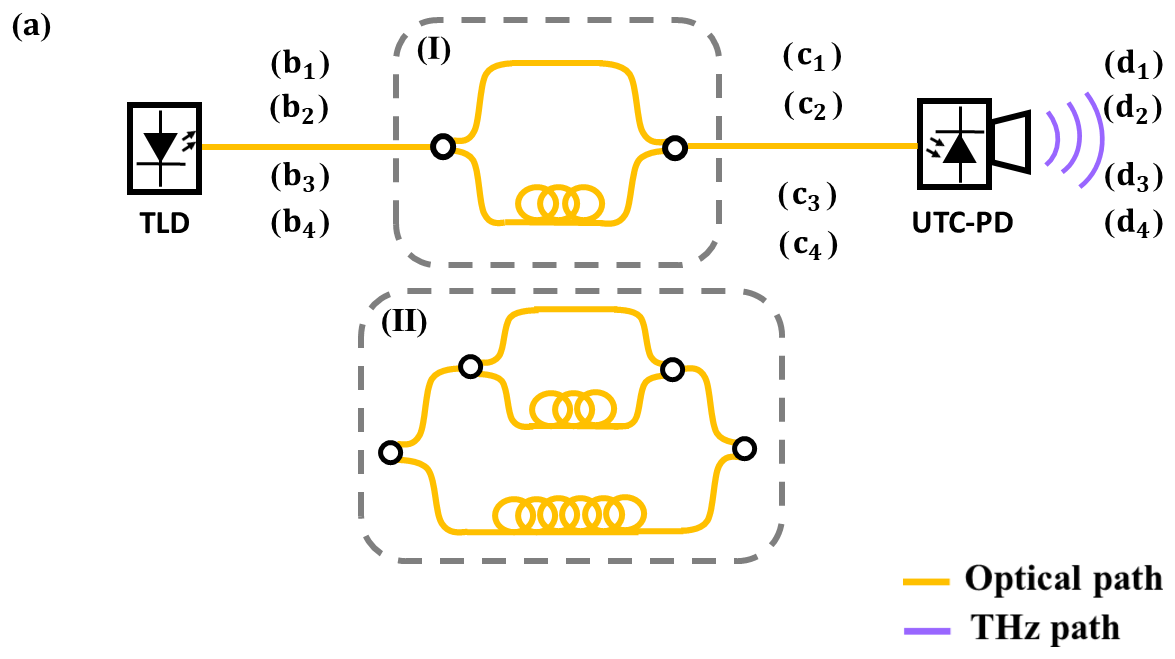
Source: Y. Wang et al., “Single-Laser Multi-Waveform THz-FMCW Signal Generation and Ranging via Photomixing in a Delayed Self-Multiplexing System,” Japanese Journal of Applied Physics, Vol. 65, 10SP01, 2026.
NEXT CHALLENGES
Our next challenge: 1–3 THz and large-scale 2D arrays
Our work so far has centered on the 300 GHz band, covering photomixers, arrays, high-frequency circuits, beam control, and communication and sensing technologies. We have since extended it to beam forming in the 600 GHz band and, in the 300 GHz band, to two-dimensional beam steering, beam hopping and 360° beam scanning with a 2×2 photomixer-antenna array.
Building on these results, our next challenges are (1) moving to higher frequencies of 1–3 THz, (2) large-scale two-dimensional photomixer arrays, and (3) high-speed two-dimensional beam control.
NEXT CHALLENGE 1 Toward 1–3 THz
From 300 GHz and 600 GHz to even higher frequencies
We aim to realize photomixers operating in the 1–3 THz range by further speeding up the photomixing technology we have developed mainly in the 300 GHz band. Alongside faster photomixers themselves, we will pursue circuits, antennas and packaging that work at terahertz frequencies, taking photonic THz technology into still higher frequency ranges.
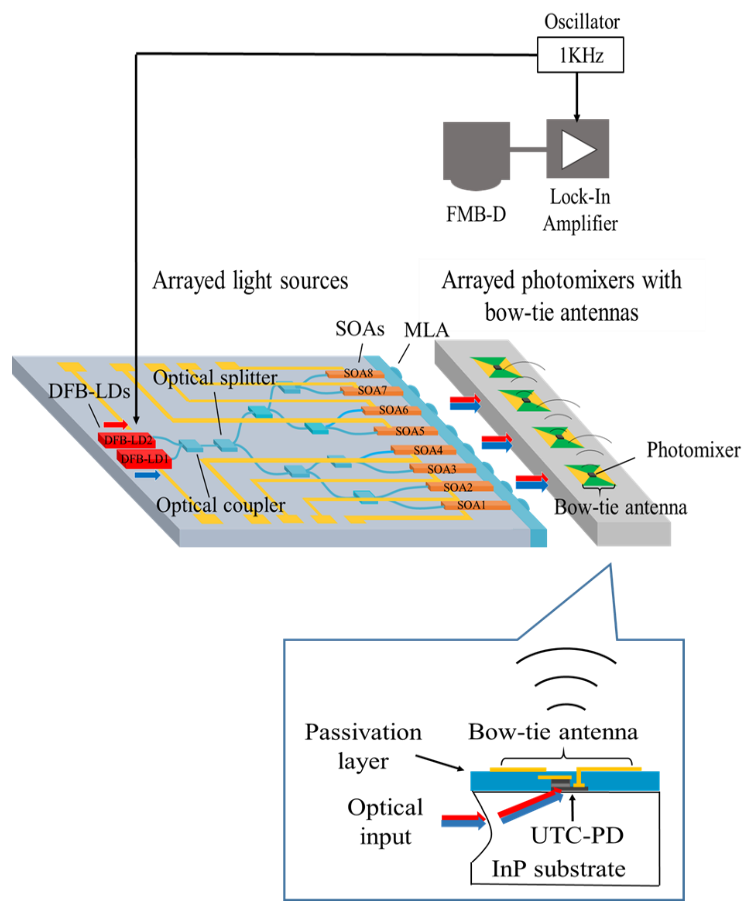
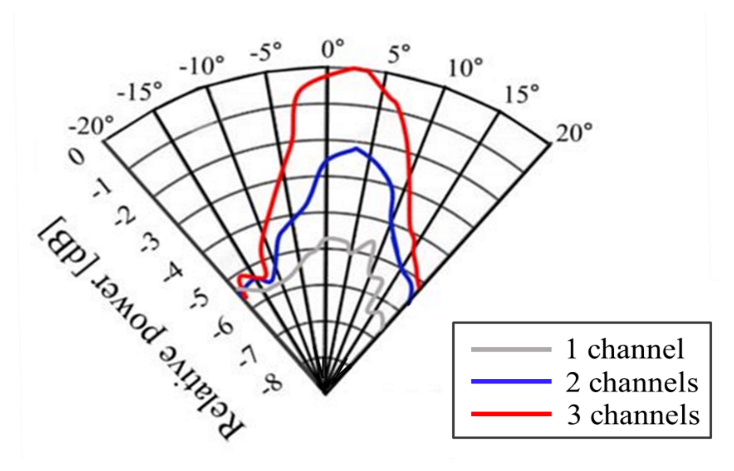
Source: Y. Kim, T. Kuboki, and K. Kato, “Demonstration of 600-GHz Wave Beam Forming by Arrayed Light Sources With Arrayed Photomixers,” IEEE Photonics Technology Letters, Vol. 33, No. 24, pp. 1435–1438, 2021. DOI: 10.1109/LPT.2021.3124826
NEXT CHALLENGE 2 Large-scale 2D photomixer arrays
From 2×2 to much larger arrays
To achieve still higher terahertz output and directivity, we will extend our research to large-scale two-dimensional arrays of photomixers and antennas. We have developed a 300 GHz-band 2D terahertz array that integrates four UTC-PDs and a 2×2 microstrip patch antenna on a SiC substrate. Integrating many more elements than the current 2×2 array, we aim to achieve high output power, high directivity and advanced spatial control at the same time.
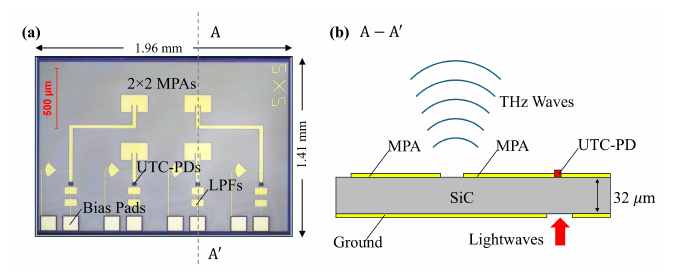
Source: B. Li, H. Ssali, Y. Li, M. Che, S. Ye, Y. Mikami, and K. Kato, “Demonstration of 2D Optoelectronic THz-Wave Beam Steering,” Electronics, Vol. 14, Article 4980, 2025. DOI: 10.3390/electronics14244980
NEXT CHALLENGE 3 High-speed 2D beam control
Steering terahertz waves freely in two dimensions
Using an optical phased array (OPA) to control the phase of the light injected into each UTC-PD, we demonstrated two-dimensional beam steering of 300 GHz-band terahertz waves with a 2×2 array. In addition to 2D beam hopping — switching the beam among azimuth angles of 60°, 180° and 300° at a fixed polar angle of 25° — we have achieved continuous 360° two-dimensional beam scanning. Next, we will introduce high-speed optical phase control to advance toward high-speed 2D beam steering, multi-beam operation and real-time beam tracking.
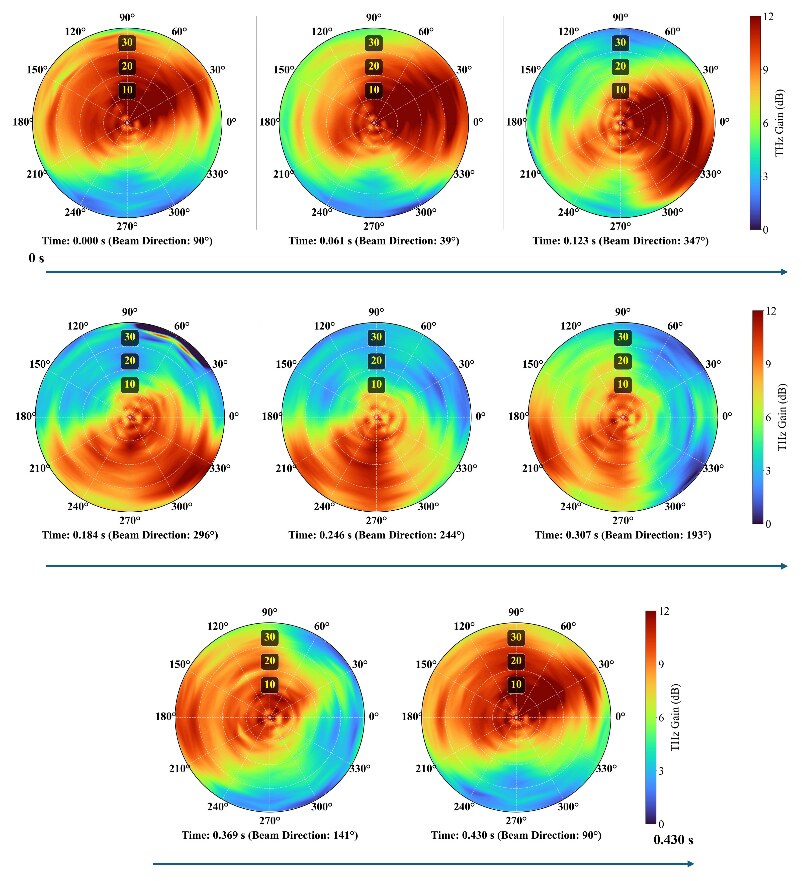
Source: B. Li, H. Ssali, Y. Li, M. Che, S. Ye, Y. Mikami, and K. Kato, “Demonstration of 2D Optoelectronic THz-Wave Beam Steering,” Electronics, Vol. 14, Article 4980, 2025. DOI: 10.3390/electronics14244980
OUR ULTIMATE GOAL
1–3 THz × Large-Scale 2D Array × High-Speed 2D Beam Control
Higher frequencies.
Larger arrays.
And faster, more versatile beam control.
We aim to develop technology that uses large-scale 2D photomixer arrays operating at 1–3 THz to control high-power terahertz waves in space, quickly and freely.